 Photo by Boitumelo on Unsplash
I've been building tools that interact with the web programmatically for a while now, and there's something about the current state of AI search that genuinely unsettles me. Not in a "the robots are coming" way. In a "we quietly handed over how billions of people find information and nobody asked any hard questions" way.
ChatGPT, Perplexity, Google AI Overviews, Microsoft Copilot — these tools now collectively shape how a massive portion of the internet-connected world gets answers. And not a single one of them fully discloses how they decide what to show you.
That should bother you. It bothers me.
The old deal was imperfect but visible
Let's be honest: traditional search was never some beacon of transparency. Google's ranking algorithm has always been a closely guarded secret. SEO practitioners spent decades reverse-engineering signals from the outside.
But there was something important about the old model that we've lost: you could see the results. Ten blue links. You could scan the titles, check the domains, decide for yourself which source to trust. If the Wall Street Journal and some random blog both appeared on page one, you got to choose which one to click. The intermediary was visible. The seams were showing.
AI search doesn't have seams. You get one synthesized answer, presented with the confidence of a textbook, assembled from sources you may never see. The intermediary is invisible. And that's a fundamentally different relationship between you and the information you consume.
The zero-click problem got worse — fast
Zero-click searches — queries where the user gets their answer directly from the search interface without visiting any website — aren't new. Google's featured snippets and knowledge panels started this trend years ago. But the numbers have accelerated in a way that should alarm anyone who cares about the open web.
Zero-click searches grew from roughly 56% to over 69% of all searches, and that trajectory has only steepened since AI-generated answers became the default experience. When Perplexity gives you a five-paragraph summary with inline citations, how often do you actually click through to the sources? Be honest. I don't either, most of the time.
This isn't just an abstract concern about information hygiene. It's an economic problem with real consequences.
Publishers are bleeding
Global publisher traffic has declined by roughly a third since AI search tools launched at scale. A third. Let that number sit for a moment.
We're talking about newsrooms, independent journalists, researchers, bloggers, documentation writers — the entire ecosystem of people who create the information that AI search tools package and present as their own product. The sources are doing the work. The AI is getting the credit, the traffic, and the ad revenue.
The response from AI companies has been... interesting. OpenAI has signed licensing deals worth $250 million or more with various publishers. On the surface, this looks like the right move — paying creators for their work. But look closer and the logic starts to unravel.
These deals effectively pay publishers for the right to make their content invisible. The AI ingests the journalism, synthesizes it into an answer, and the user never visits the publisher's site. The publisher gets a licensing check, but they lose the direct relationship with readers, the ability to serve their own ads, the chance to convert a visitor into a subscriber. They're being paid to become invisible, and the check is a fraction of what direct traffic was worth.
It's a deal that sounds generous until you realize it's compensation for being made obsolete.
Google's transparency double standard
Here's something that doesn't get discussed enough: Google publishes extraordinarily detailed Search Quality Evaluator Guidelines for its traditional search product. It's a 170+ page document that explains how human raters should assess search results, what constitutes quality content, how expertise and authority are evaluated. It's not the algorithm itself, but it's a meaningful window into the principles behind the system.
For AI Overviews? Nothing equivalent exists. Google rolled out AI-generated answers to billions of queries and published no comparable framework for how those answers are assembled, how sources are selected, how conflicting information is resolved, or how the system decides what to emphasize and what to omit.
This is the same company. The same search product. Two completely different standards of transparency. Traditional search gets a public rulebook. AI search gets "trust us."
The charitable interpretation is that AI Overviews are new and the frameworks haven't caught up yet. The less charitable interpretation is that opacity is a feature, not a bug — it's harder to game a system nobody understands, and it's harder to criticize editorial choices nobody can see.
Perplexity's impossible promise
I want to talk about Perplexity specifically, because they've positioned themselves as the "transparent" AI search engine, and I think the tension in their model is revealing.
Perplexity does show citations. That's genuinely better than nothing, and I give them credit for it. You can see which sources contributed to an answer, and that's more than most competitors offer.
But here's the tension: Perplexity's entire value proposition is that you don't have to visit those sources. The product is the summary. The convenience is not clicking through. Every improvement they make to the quality of their answers reduces the incentive to check the citations they dutifully display.
It's like a restaurant that posts the recipe on the wall but makes the food so convenient you never cook at home. The transparency is real, but it doesn't change the economic outcome. Publishers still lose the visit. The citation is a fig leaf over the same zero-click dynamic.
And this isn't a criticism unique to Perplexity — they're just the clearest example because they explicitly claim transparency as a differentiator. The problem is structural. Every AI search tool that synthesizes answers from web sources faces the same fundamental conflict: the better the synthesis, the less the source matters.
The developer's hallucination problem
If you're building applications that use AI search — retrieval-augmented generation, AI agents, automated research tools — the transparency gap isn't just a philosophical concern. It's a practical engineering problem.
When your AI-powered application produces an incorrect answer, how do you debug it? If the search layer is a black box, you're stuck. You know the output is wrong, but you can't trace back to figure out why. Was it a bad search query? Did the retrieval miss a relevant source? Did it find the right source but extract the wrong information? Did it synthesize two contradictory sources and pick the wrong one?
Without visibility into the search process, debugging hallucinations becomes guesswork. You're tuning prompts and hoping for the best, which is not engineering. It's prayer.
I've talked to developers who build AI applications on top of third-party search APIs, and the most common frustration I hear isn't about accuracy — it's about observability. They can't see what happened between the query and the answer. The search is a black box with an input and an output, and the space in between is a mystery.
This matters because hallucinations in AI search aren't random. They have causes — specific, traceable causes rooted in how queries were constructed, which sources were retrieved, how information was extracted, and how conflicts were resolved. But if you can't see any of that, every hallucination is equally mysterious, and you can't systematically improve your system.
The case for showing your work
I think there's a strong case — not just a moral one, but a practical one — for AI search that shows its work.
When a human researcher writes a report, we expect citations. When a journalist publishes a story, we expect sources. When a scientist presents findings, we expect methodology. We have these expectations because we've learned, over centuries, that the process matters as much as the conclusion. Knowing how someone arrived at an answer is essential to evaluating whether the answer is trustworthy.
AI search has somehow exempted itself from this standard. It presents synthesized answers with the authority of a reference work and the accountability of a rumor. "Here's your answer. Where did it come from? Somewhere. How did we decide this was right? We have a model. Can you check our work? Not really."
Transparent AI search means showing the queries that were executed, the sources that were found, the information that was extracted, and the reasoning that led to the synthesis. Not as an afterthought. Not as a footnote. As a core part of the experience.
There are legitimate counterarguments. Showing too much process can overwhelm users who just want a quick answer. Exposing query strategies could enable manipulation. Some level of abstraction is necessary for usability. I acknowledge all of that.
But the current state isn't a careful balance between transparency and usability. It's near-total opacity presented as a feature. And the people most affected — publishers losing traffic, developers debugging hallucinations, users making decisions based on AI-generated answers — deserve better.
What transparency actually looks like
This transparency problem is exactly what motivated us to build the Research Agent feature at link.sc. The idea is straightforward: when an AI searches the web on your behalf, you should be able to see every query it ran, every source it found, every piece of information it extracted, and every reasoning step it took to arrive at its conclusion.
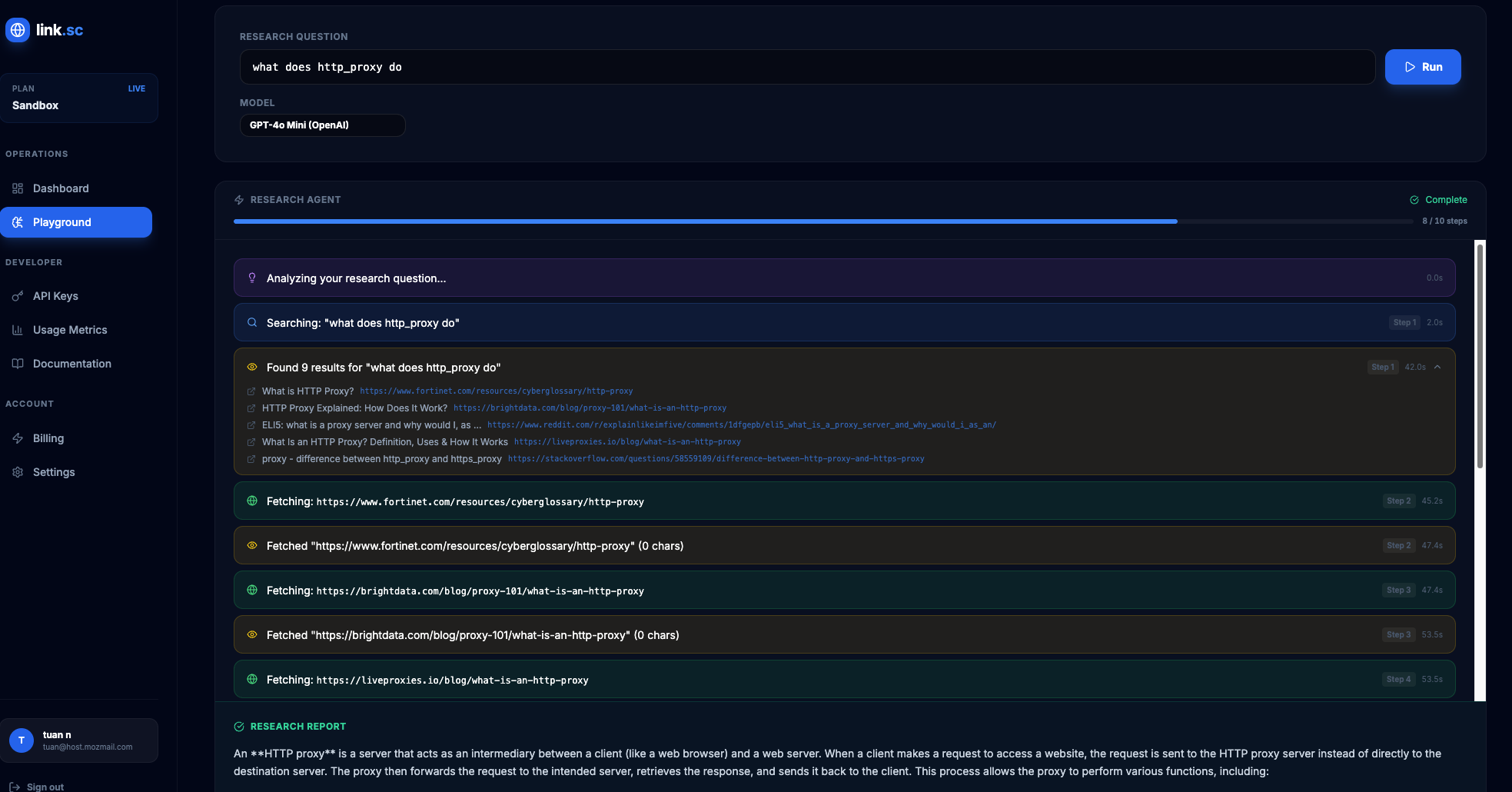 The link.sc Research Agent in action — every search query, every fetched page, every decision streamed live.
Not because most users will scrutinize every step. But because the option should exist. Because when something looks wrong, you should be able to trace it. Because "trust me" is not an acceptable answer when the stakes include what people believe to be true.
We think AI search should work like a good research assistant: someone who not only gives you answers but shows you their notes, tells you where they looked, and flags when sources disagreed. The output should be a synthesis, but the process should be auditable.
This isn't a radical idea. It's just applying the standards we've always had for human research to the tools that are replacing human research.
The transparency gap is a choice
The most important thing I want to leave you with is this: the opacity of AI search is not a technical limitation. It's a choice.
These systems know what they searched for. They know which sources they retrieved. They know how they resolved conflicts between sources. They have this information internally — they just don't show it to you.
The question is why. And the answers range from "it's simpler for users" to "it's harder to game" to "it protects our competitive advantage." Some of those reasons are legitimate. None of them are sufficient to justify the current state of affairs, where tools that shape the information diet of billions of people operate with less transparency than a Wikipedia article.
We can build AI search that's both powerful and transparent. That gives quick answers when you want them and deep traceability when you need it. That respects the sources it draws from and empowers the users it serves.
We just have to decide that transparency matters enough to build for it.
We built link.sc's Research Agent because we believe AI search should show its work. Watch an AI search the web in real-time — every query, every source, every reasoning step. Try it free.