 Photo by Clay Banks on Unsplash
I want to talk about a problem that should be keeping more people up at night: the tools we're increasingly relying on to find and synthesize information are getting it wrong — a lot — and they don't tell you when they're guessing.
We've entered an era where AI search engines don't just retrieve documents. They read, summarize, and present answers as though they've done the homework for you. Millions of people now treat ChatGPT, Perplexity, Google's AI Overviews, and similar tools as their primary research interface. And according to a growing body of research, these tools fabricate citations, misattribute claims, and present speculation with the same polished certainty as verified fact.
Let me walk you through what the data actually says, why it matters for developers, and what the path forward looks like.
The Research: How Bad Is It, Really?
The Tow Center for Digital Journalism at Columbia University published one of the most rigorous analyses of AI search citation accuracy to date. Researchers systematically tested queries across eight major AI-powered search platforms and checked whether the citations these tools provided actually supported the claims being made.
The results were not encouraging.
Citation accuracy across the platforms they tested ranged from roughly 40% to 75%, depending on the tool and the type of query. That means on the low end, more than half of the citations an AI search engine hands you either don't say what the AI claims they say, don't exist at all, or point to the wrong source entirely.
Think about that for a second. If a human research assistant got their citations right only 40% of the time, you'd fire them. But when an AI does it with a clean interface and confident tone, we nod along and paste the answer into our work.
The study broke down failures into several categories: completely fabricated URLs that lead nowhere, real URLs that don't contain the claimed information, sources that are misattributed to the wrong author or publication, and claims that are directionally correct but materially distorted in the summary. Each category represents a different flavor of the same fundamental problem — these systems prioritize fluent, authoritative-sounding output over accuracy.
Perplexity: The Plagiarism Problem
Perplexity has positioned itself as the "answer engine" — the tool that searches the web so you don't have to. It's raised hundreds of millions in funding on this premise. But it's also been caught doing something that undermines the entire value proposition: essentially plagiarizing content from publishers while claiming to cite them properly.
Multiple investigations, including reporting from Forbes and Wired, found that Perplexity was reproducing near-verbatim passages from paywalled articles, sometimes restructuring sentences just enough to avoid exact duplication while preserving the substance wholesale. In some cases, the tool presented information from sources it apparently never actually accessed, generating citations that looked correct but pointed to content that didn't match.
This is a deeper problem than simple inaccuracy. It's a system that creates the appearance of rigorous sourcing while actually doing something closer to sophisticated paraphrasing. The citations become a kind of theater — they look like verification, but they're closer to decoration.
For anyone building products that depend on accurate web research, this distinction matters enormously. A citation that looks right but isn't is arguably worse than no citation at all, because it gives users false confidence in the output.
Google AI Overviews: The Glue-on-Pizza Moment
When Google rolled out AI Overviews in Search, it was supposed to be the beginning of a new era for information retrieval. Instead, the launch became a case study in what happens when you deploy generative AI at scale without adequate guardrails.
The greatest hits from those early days are now internet folklore: the AI confidently advised users to add glue to pizza sauce to help cheese stick better (sourced from an obvious joke on Reddit). It told people that eating rocks had nutritional benefits. It recommended using gasoline to make spaghetti cook faster.
Google cleaned up the most egregious examples quickly, and the system has improved since launch. But the episode revealed something important about the architecture of these systems. They don't distinguish between authoritative sources and satire. They don't flag uncertainty. They compress the entire messy, contradictory web into a single confident answer and present it as though Google itself is vouching for it.
The errors weren't bugs. They were the predictable result of a system that optimizes for fluent summarization over factual verification.
The Confidence Gap
This brings me to what I think is the most dangerous aspect of AI search as it exists today: the confidence gap.
When a human expert tells you something, you can read their hedging. They say "I think," "the evidence suggests," "there's some debate about this." You can calibrate your trust based on their tone, their credentials, and the context. When they're unsure, they usually signal it.
AI search engines don't do this. They present every answer — whether it's backed by a dozen peer-reviewed studies or extracted from a single Reddit comment — with the same clean, authoritative formatting. The typography is the same. The sentence structure is the same. There's no uncertainty gradient.
This is a design choice, not a technical limitation. These systems could flag low-confidence answers. They could indicate when sources conflict. They could show you that they found three sources saying one thing and two sources saying the opposite. Instead, they flatten all of that nuance into a single fluent paragraph that reads like it came from an encyclopedia.
I've watched developers paste AI search results directly into documentation, product specs, and even code comments without checking the underlying sources. Not because they're lazy — because the output is engineered to feel trustworthy. The confidence gap is a UX problem masquerading as an accuracy problem.
What This Means for Developers Building RAG Pipelines
If you're building retrieval-augmented generation systems — and if you're reading this blog, there's a good chance you are — the citation accuracy data from these studies should be a flashing red warning sign.
Here's the practical problem: most RAG implementations treat the retrieval step as relatively trustworthy. You search, you get sources, you stuff them into context, and the model generates an answer grounded in those sources. The assumption is that the retrieval provides the factual foundation and the generation provides the synthesis.
But if the search layer itself is introducing errors — returning sources that don't match queries, hallucinating URLs, misattributing claims — then your RAG pipeline has a rotten foundation. You're building on sand and hoping the model somehow corrects upstream errors. It won't. It'll amplify them.
A few concrete takeaways:
Never trust a single search pass. If your pipeline runs one query and uses whatever comes back, you're inheriting all the accuracy problems described above. Multiple queries, cross-referencing, and source validation aren't optional — they're the difference between a useful system and a confident-sounding liability.
Verify URLs exist and contain what you think they contain. This sounds obvious, but I've seen production RAG systems that never actually fetch and validate the sources they cite. They pass through URLs from the retrieval layer without checking whether those URLs are live, whether they contain the claimed information, or whether they've been updated since indexing.
Build transparency into the pipeline. If you can't show a user exactly what was searched, what was found, and how the answer was assembled, you're building a black box. And as we've seen, black boxes in AI search produce errors that are invisible until they cause damage.
Treat citation generation as a separate, auditable step. Don't let the model generate citations as part of its fluent output. Extract them, verify them, and present them in a way that lets users check the work.
The Transparency Problem
This is the core issue, and it extends beyond any single study or platform: you can't audit what you can't see.
When you use Perplexity or ChatGPT's search feature, you get a polished answer with some inline citations. But you don't see what queries the system actually ran. You don't see which pages it fetched and which it ignored. You don't see how it decided to weight one source over another. You don't see whether it found contradictory information and chose to suppress it.
The entire reasoning process is hidden behind an API call that takes in a question and emits an answer. And that opacity is exactly where the errors hide.
This is why I believe the next generation of AI search tools needs to be built around radical transparency. Not just "here are some sources" — but the full chain: what was searched, what was retrieved, what was extracted from each source, and how the final answer was assembled.
This is exactly why we built the Research Agent at link.sc. Full transparency into every search query, every page fetched, every reasoning step.
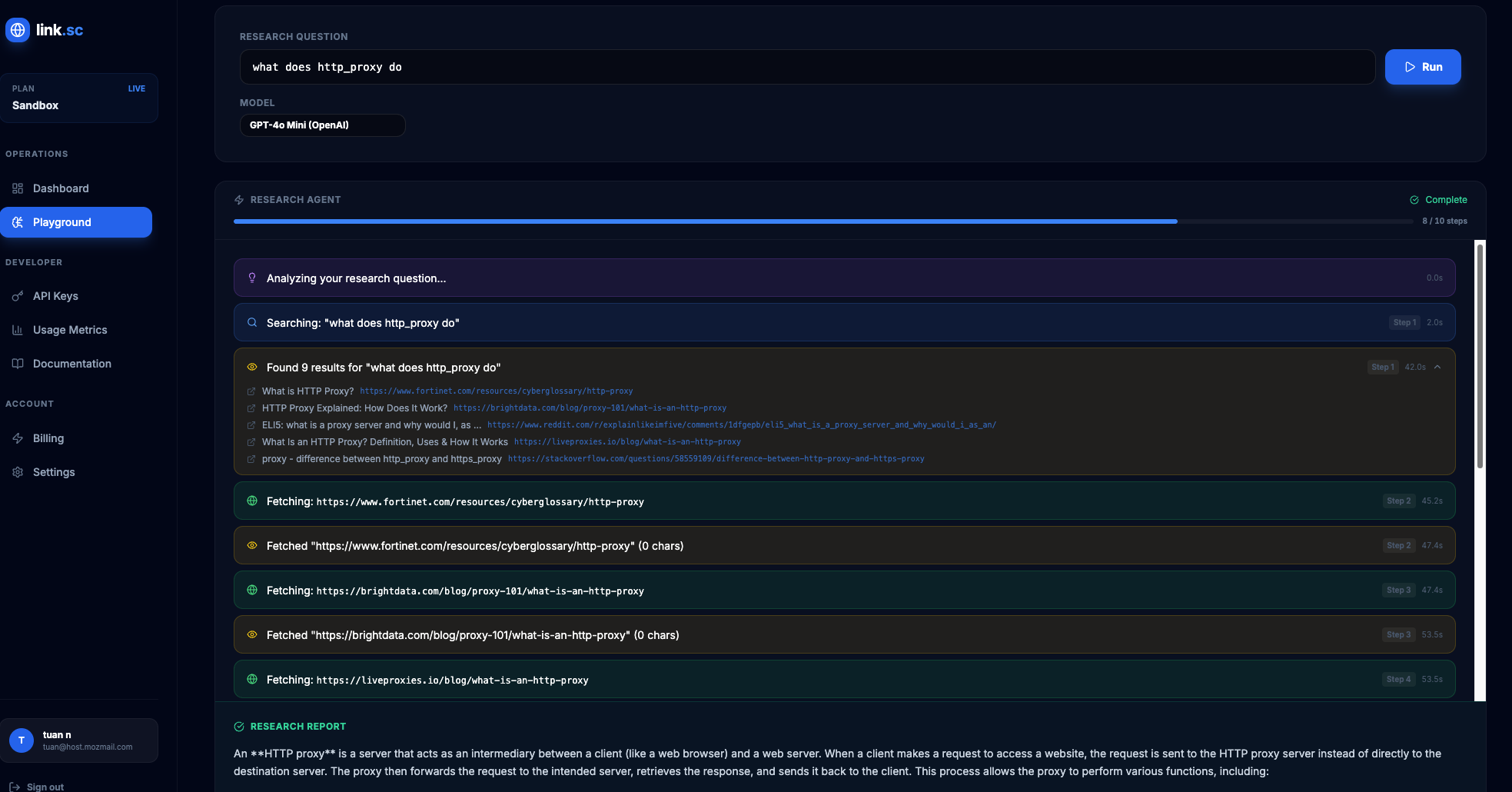 The link.sc Research Agent lets you trace every claim back to its source — every query, every page fetched, every reasoning step visible in real time.
When our system generates an answer, you can trace every claim back through the actual content that was retrieved. You can see the queries that were run. You can see what the AI found versus what it claims. There's no hidden layer between the web and the output.
I'm not saying our approach is the only valid one. But I am saying that opacity is not a feature — it's a liability. And any serious AI search tool should let you audit the pipeline end to end.
What This Means for Content Creators
There's an angle here that gets less attention but matters a lot: if you're a content creator or publisher, the accuracy of AI search directly affects how your work gets represented.
The Tow Center research and subsequent analyses suggest that structured, authoritative content gets cited more accurately than informal or ambiguous writing. Pages with clear headings, explicit claims, proper sourcing, and structured data tend to fare better in AI search citation than content that's conversational or relies heavily on context.
This doesn't mean you should write like a robot. It means that the technical structure of your content — semantic HTML, clear section headers, explicit attribution, structured data markup — now serves a dual purpose. It helps human readers navigate your work and it helps AI systems accurately extract and cite your claims.
If your content is getting misrepresented by AI search tools, part of the fix might be making your content more machine-readable. It's not a complete solution — the tools themselves need to get better — but it's the part you can control.
Where Do We Go from Here?
I don't think AI search is doomed. The underlying technology is genuinely powerful, and for many use cases, it's already more efficient than manually sifting through ten blue links. But we're in a dangerous middle period where the tools are good enough to be trusted and bad enough to be wrong in ways that are hard to detect.
The fix isn't going to come from better models alone. It's going to come from better architecture — systems that separate retrieval from generation, that verify before they cite, that show their work, and that flag uncertainty instead of hiding it.
Until then, my advice is simple: don't trust AI search output without checking the sources. If the tool won't show you the sources, don't trust the tool. And if you're building on top of these systems, build verification into every layer of your pipeline.
The 40-75% citation accuracy range isn't a temporary glitch. It's a structural feature of systems that were designed to sound right rather than be right. And until the industry takes transparency seriously, that gap between confidence and accuracy is going to keep catching people off guard.
Tired of AI search being a black box? link.sc's Research Agent shows you every step — every query, every source, every decision. See for yourself what the AI actually found. Get started free.